


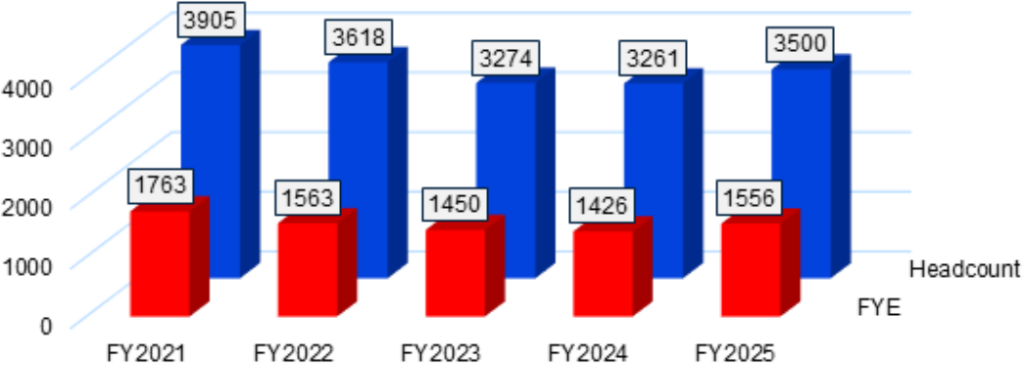
Minnesota State (MinnState) utilizes a credit-based enrollment system, known as Full Year Equivalence, to track enrollment patterns across all MinnState institutions. The credits produced at each campus are divided by 30, allowing us to see how many “full-time” students each campus is serving. The chart below includes the credits produced by both undergraduate and concurrent students.
Fiscal Year Final FYE & Headcount
Race & Ethnicity Composition
All race and ethnicities are self-reported. Race and ethnicity categories were developed in 1997 by the Office of Management and Budget (OMB) and describe groups to which individuals identify or belong in the community’s eyes. The categories do not denote scientific definitions of anthropological origins. All categories align with the IPEDS reporting algorithm.
Undergraduate Student Race Composition

Twenty-seven percent of Northland’s Undergraduate student body reports a race/ethnicity other than white. Students of Color (SOC) include any student with a race/ethnicity of Asian, Black/African American, Native American/Native Alaskan, Native Hawaiian/Pacific Islander, and/or Hispanic/Latino.
Student Gender Composition
Gender refers to the socially constructed roles, behaviors, activities, and attributes that a given society considers appropriate for boys and men or girls and women. While aspects of biological sex are similar across different cultures, aspects of gender may differ. Following Minnesota State guidelines, Northland reports gender in the binary (men/women) categories.
Undergraduate Student Gender Composition
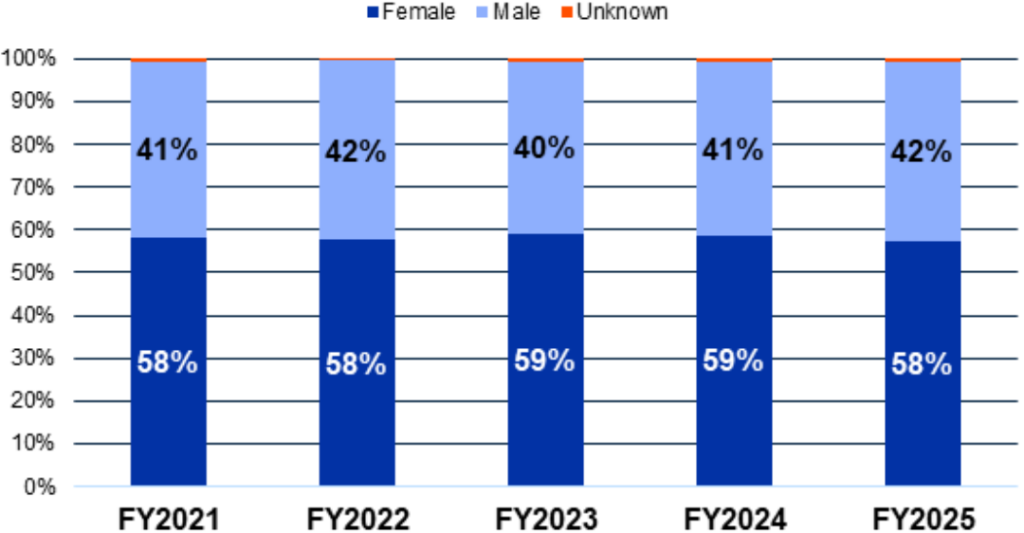
Fifty-eight percent of Northland’s Undergraduate student body is female, and 42% is male.
First Generation (MN) Composition
The Minnesota Department of Education defines first-generation students as individuals whose parents have not attended a post-secondary institution.
Undergraduate First Generation Composition (Minnesota)
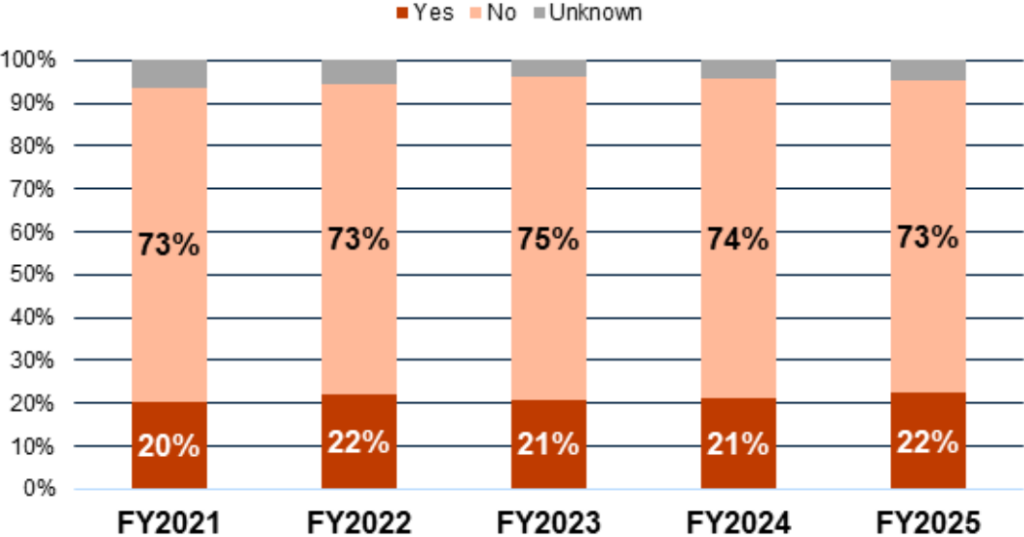
Twenty-two percent of the undergraduate student body had neither parent attend post-secondary education, compared to 60% of students who may have had a parent participate in post-secondary education but neither has earned a bachelor’s degree.
Low Income Composition
A student who applied for a federal Pell Grant, an award for undergraduates who display exceptional financial need and who have not earned a bachelor’s, graduate, or professional degree, and was determined to be eligible. (U.S. Department of Education, n.d.)
Undergraduate Low Income Composition

Forty-five percent of undergraduates are eligible to receive the Pell Grant. Northland does not have access to 31% of the student body’s financial needs. In FY2025, 42% of undergraduates received funds through the Pell Grant.
Data on this page is updated annually by October 31.