
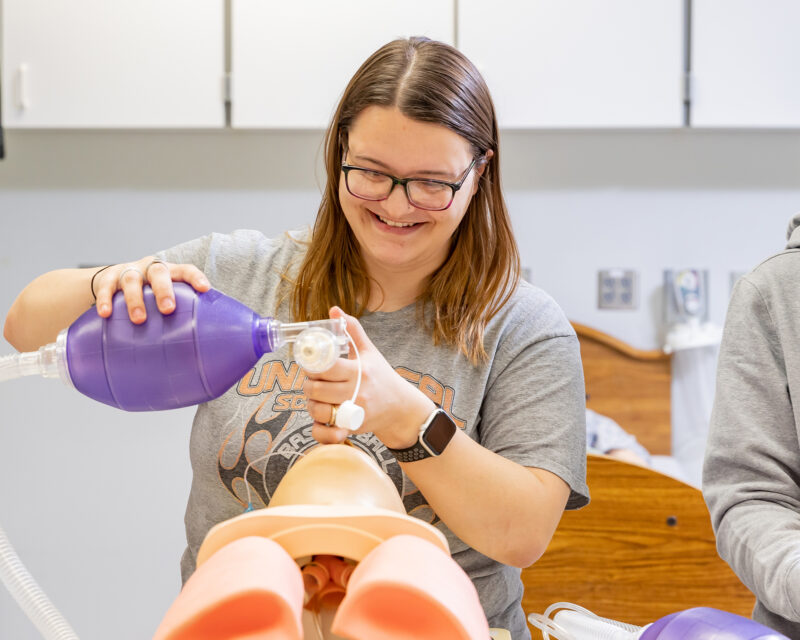
As a Respiratory Therapist you can hold an exciting position on the health care team. Under the supervision of a physician, the Respiratory Therapist is responsible for oxygen and gas therapy, care of patients with cardiopulmonary problems including cardiopulmonary arrest, delivery of aerosolized medication, chest physiotherapy, obtaining and analyzing arterial blood gas specimens, pulmonary function testing, maintenance of patients in need of mechanical ventilators, and education of patients and families. University of Minnesota-Crookston offers students the opportunity to transfer into designated baccalaureate programs; Bachelor of Science in Technical Studies (Empahsis Respiratory Care), or in Applied Management-Health Management.
Northland offers a multitude of opportunities, whether you're beginning your degree or returning to college. We're affordable, convenient, and flexible. Take your life North at Northland.
Feel like you need a little more direction? Our GPS LifePlan website helps students set goals and design plans that will lead them to the success they desire. Consult our GPS LifePlan website for information for your career, work, and educational planning!
The program is accredited by the:
Commission on Accreditation for Respiratory Care (www.coarc.com)
1248 Harwood Road
Bedford, Texas 76021-4244
(817) 283-2835
Northland Community & Technical College is accredited by the Higher Learning Commission of the North Central Association of Colleges and Schools.
1. Appropriate Accuplacer scores or successful completion of ENGL0095, MATH0090 must be completed before entering any RESP courses. Acceptance into the Respiratory Therapist program requires an information session with the program advisor. All eligible students are allowed to enroll until program enrollment capacity is reached.
2. Minnesota Department of Human Services Licensing Division Background study must be completed upon program entry and annually thereafter. Evidence of approval to provide healthcare must be on file prior to entering second semester courses.
3. A laptop computer is required for semester four through six.
4. All required courses for the program must be completed with a grade of “C” or better.
5. Immunization and health screening data must be submitted on the college Health Screening Form prior to enrollment in RESP courses.
6. Current CPR certification. CPR for Health Care Providers (American Heart Association) or CPR for Professional Rescuer (Red Cross).
Required Courses |
||
| Course # | Course Name | Credits |
|---|---|---|
| CPTR 1104 | Intro to Computer Tech | 3 credits |
| EMTP 2230 | ACLS | 1 credits |
| EMTP 2234 | Pediatric Adv Life Suppor | 1 credits |
| EMTP 2236 | Neonatal Resuscitation Pr | 1 credits |
| HLTH 1106 | Medical Terminology | 2 credits |
| HLTH 2002 | Pharmacology | 2 credits |
| RESP 1104 | Non Acute Resp Care | 4 credits |
| RESP 1110 | Adult Critical Care | 4 credits |
| RESP 1120 | Cardio Physiology/Assess | 3 credits |
| RESP 1124 | Clinical I | 3 credits |
| RESP 2206 | Clinical II | 3 credits |
| RESP 2211 | Summer Clinical | 2 credits |
| RESP 2212 | Diagnostic Procedures | 3 credits |
| RESP 2242 | Pediatric/Neonatal Care | 4 credits |
| RESP 2248 | Clinical III | 3 credits |
| RESP 2252 | Advanced Critical Care | 4 credits |
| RESP 2258 | Clinical IV | 3 credits |
| RESP 2260 | Spring Internship | 1 credits |
| RESP 2262 | Summer Internship | 3 credits |
| RESP 2276 | Adv Prac Registry Review | 3 credits |
| BIOL 2221 | Microbiology | 3 credits |
| BIOL 2252 | Anatomy & Phys I | 3 credits |
| BIOL 2254 | Anatomy & Phys II | 3 credits |
| CHEM 1020 | Intro to Chemistry | 4 credits |
| ENGL 1111 | Composition I | 3 credits |
| MATH 1110 | College Algebra | 3 credits |
| PSYC 1105 | Intro to Psychology | 3 credits |
| G6: Human/Fine Arts Elec ( *See Elective Options Listed Below ) | 3 credits | |
| TOTAL CREDITS: | 78 credits | |
Program Specific Elective Course Options |
||
Electives for this program may be selected from the following list of courses below. Need help? Schedule an appointment with a Northland Academic Advisor for assistance in selecting courses. |
||
| Course # | Course Name | Credits |
Humanities/Fine Arts Electives |
||
| PHIL 1101 | Intro to Philosophy | 3 credits |
| PHIL 1102 | Intro to Ethics | 3 credits |
| PHIL 2210 | Morals and Medicine | 3 credits |
1. Student will communicate effectively with patients, families, physicians, and colleagues based upon respect for the dignity and work of each person.
2. Student will apply principles of basic sciences to the required duties and skills in the practice of respiratory care.
3. Student will perform safely and accurately, entry-level clinical tasks in a structured health care setting.
4. Student will perform job duties within existing ethical and legal parameter for healthcare professionals.
5. Student will exhibit professional characteristics, behaviors, and attitudes appropriate to scope of practice for respiratory care practitioners.
6. Student will perform accurate and efficient patient assessments according to policies and procedures required of respiratory care practitioner professionals.
7. Student will accurately interpret and integrate patient data.
8. Student will apply safety and infection control measures to patient care at all times in the classroom, lab, and clinic or hospital setting.
Counselors are available in the Career Center to assist with career advising, job search resources, employer connections, occupational descriptions, employment outlook, earnings, education/training requirements and sources.
The graduate of the AAS in Respiratory Care will be eligible, as required by the National Board of Respiratory Care (NBRC), to take first the entry Level exam, followed by the advanced level examination to be credentialed as a Registered Respiratory Therapist (RRT). Both levels require national credentialing examinations to earn the credentials of Certified or Registered respectively. Demand for the Respiratory Care Practitioner is very high, with a nationwide projected increase of over 50%.
The employment outlook for respiratory therapists in the state of Minnesota from 2009 to 2019 is 26.5%, a well above average growth percentage.